
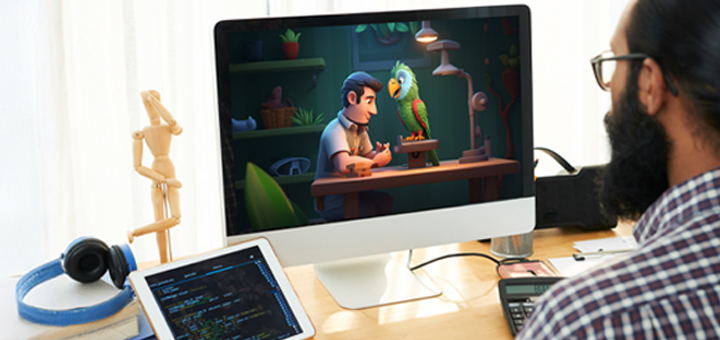
Animation today is much more than entertainment. It has quietly become a powerful communication tool that industries use to simplify ideas, train teams, promote products, and create engaging digital experiences. From visually stunning films and interactive video games to medical simulations and virtual property tours, animation is shaping how information is presented and understood.
As digital platforms continue to grow and immersive technologies like AR and VR become more common, animation is also emerging as a promising career choice. This is why many students are exploring professional programs such as BSc in Animation and VFX, which help them develop both creative thinking and technical expertise.
Understanding where animation is used and why it matters can help students make informed career decisions and explore opportunities in this evolving field.
Which Industries Use Animation?
Film and Entertainment
The film industry is one of the biggest users of animation and visual effects. Modern movies rely heavily on CGI, motion graphics, and 3D animation to create scenes that would otherwise be impossible or extremely expensive to shoot.
For example, fantasy landscapes, superhero action sequences, or large-scale disaster scenes are often created digitally using animation techniques. Students pursuing BSc in Animation and VFX are trained in similar tools and production workflows used in real film studios.
Gaming Industry
Animation plays a crucial role in making games immersive and interactive. From character movement and facial expressions to environment design and storytelling cutscenes, animation shapes the entire gaming experience.
A simple example can be seen in open-world games where changing weather, realistic lighting, and smooth character transitions make gameplay feel more lifelike. Courses like B Sc in Gaming and VFX prepare students to work with game engines, design interactive visuals, and build engaging virtual worlds.
Advertising and Marketing
Brands increasingly use animated videos to communicate product features and connect with audiences online. Short animated explainer videos on social media often perform better than static posts because they are easier to understand and more engaging.
For instance, a startup launching a mobile app might use animation to show how users can complete tasks quickly, helping build trust and improve brand recall. This growing demand encourages students to search for the best colleges for BSc in Animation and VFX that offer industry exposure and practical learning opportunities.
Education and E-Learning
Animation has transformed digital learning by making complex subjects easier to grasp. Educational platforms use animated visuals to explain scientific processes, historical timelines, and technical concepts in an engaging way.
Imagine a physics lesson where gravitational force is demonstrated through motion graphics or a biology module showing a 3D animated human organ system. Graduates from BSc in VFX and Animation programs often contribute to developing such educational content.
Healthcare and Medical Training
In healthcare, animation helps professionals and patients understand complicated procedures. Hospitals and medical institutions use animated simulations to train doctors and nurses or explain treatments to patients.
For example, a patient preparing for surgery may watch an animated walkthrough of the procedure, which helps reduce fear and improve communication with medical staff.
Architecture and Real Estate
Architectural animation allows clients to explore buildings before they are constructed. Through virtual walkthroughs and 3D visualization, buyers can experience layouts, interiors, and lighting conditions.
Real estate developers frequently use animated presentations to help investors and customers make confident decisions about projects.
Corporate and Industrial Training
Many companies use animation for employee training and safety awareness programs. Animated simulations allow workers to understand machine operations or emergency procedures without real-world risks.
Manufacturing firms, for instance, often use animated guides to train new employees efficiently while reducing training costs.
Why is Animation Important in Different Industries?
Simplifies Complex Information
Animation helps explain technical processes and abstract ideas visually. Whether it is a scientific concept or a product feature, visual storytelling makes information easier to understand.
Improves Engagement
In today’s fast-paced digital environment, animated content captures attention quickly. Businesses use animation to increase website interaction, improve social media reach, and enhance marketing effectiveness.
Enhances Learning and Retention
Visual learning improves memory retention. This is why animation is widely used in education, corporate training, and professional skill development programs.
Strengthens Brand Communication
Animated characters, motion graphics, and storytelling techniques help companies build unique brand identities and connect emotionally with audiences.
Supports Digital Transformation
As industries move toward digital platforms, animation has become a key tool for communication and innovation. It is widely used in mobile applications, virtual reality experiences, and interactive media solutions.
Creates Diverse Career Opportunities
The increasing use of animation has opened up roles such as animator, VFX artist, game designer, motion graphic designer, and multimedia specialist. Students who choose structured programs gain exposure to industry software and practical project experience that prepares them for these careers.
Conclusion
Animation has evolved into a strategic tool that influences how industries communicate, educate, market, and innovate. Its applications now extend far beyond entertainment into sectors like healthcare, architecture, corporate training, and digital marketing.
Programs such as BSc in Animation and VFX , BSc in VFX and Animation, and B Sc in Gaming and VFX are helping students build the creative and technical skills needed to succeed in this rapidly growing field. As demand continues to rise, identifying the best colleges for BSc in Animation and VFX becomes an important step toward building a successful and future-ready career.
In the modern digital world, animation is not just about creativity it is about shaping experiences, solving communication challenges, and driving innovation across industries.
FAQs
-
Is animation only used in movies and cartoons?
No, animation is widely used in industries such as gaming, education, healthcare, advertising, architecture, and corporate training. -
What career options are available after BSc in Animation and VFX?
Students can work as animators, VFX artists, game designers, motion graphic designers, multimedia specialists, or 3D modelers. -
Why is animation important in digital marketing?
Animated content simplifies messages, increases engagement, and improves brand recall, making marketing campaigns more effective. -
How do I choose the best colleges for BSc in Animation and VFX?
Students should consider factors like industry exposure, software training, placement support, faculty expertise, and practical project opportunities. -
Is gaming a good career option after studying animation?
Yes, the gaming industry is growing rapidly and offers opportunities in game design, environment creation, character animation, and interactive storytelling.